Thread by Thread: How a Digital Generation Is Accidentally Saving America's Embroidery Heritage
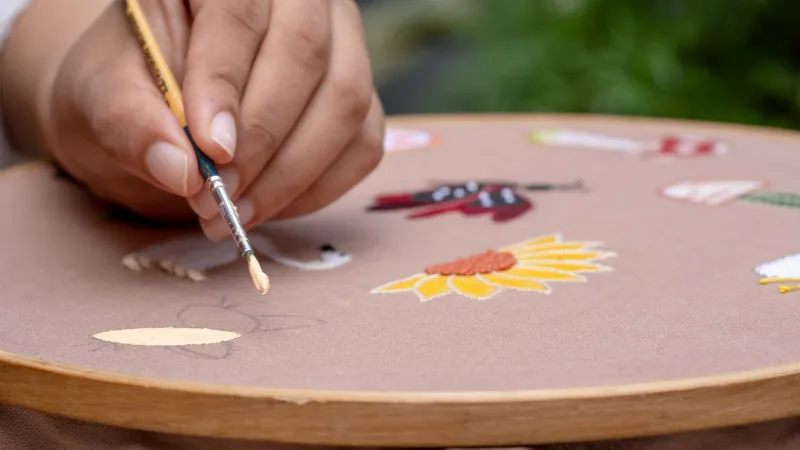
Somewhere between a trending audio clip and a centuries-old stitching pattern, something quietly remarkable is happening in American craft culture. Embroidery — long dismissed as a domestic relic, a grandmother's pastime, a skill with no commercial future — is experiencing a resurgence so unexpected in its origins that even its most devoted practitioners are still trying to make sense of it.
The numbers are difficult to ignore. Embroidery-related hashtags on TikTok have accumulated billions of views. Independent craft supply shops report that embroidery hoops and floss have become among their fastest-moving inventory items. And perhaps most significantly, a generation of young Americans who had never threaded a needle before 2020 is now actively seeking instruction from elderly textile artists whose regional knowledge was, until very recently, in genuine danger of dying with them.
This is not a story about nostalgia. It is a story about what happens when the velocity of digital culture collides, accidentally and sometimes awkwardly, with the patience that authentic craft demands.
The Algorithm's Unlikely Gift
For Marguerite Hollis, a 74-year-old practitioner of Appalachian whitework embroidery in eastern Tennessee, the past three years have felt surreal. After decades of teaching small workshops to dwindling classes, she received, in the spring of 2022, a message through a platform she had only recently learned to navigate. A 22-year-old in Portland, Oregon, had seen a brief video of Hollis's pulled-thread technique and wanted to know if she offered remote instruction.
"I thought it was a mistake at first," Hollis says. "I'd been trying to find students for years. Then suddenly I had a waiting list."
Hollis is not an anomaly. Across the country — in the Pennsylvania Dutch corridor, in the Gulf Coast's Creole textile communities, in the Mexican-American embroidery traditions of the Southwest — older practitioners are reporting a similar phenomenon: an influx of young people, many of them entirely self-taught to a point, arriving with genuine curiosity about techniques they encountered through a screen.
What the algorithm accelerated was visibility. What it could not provide was depth.
The Tension Between Viral and Authentic
Not everyone within the embroidery community greets this development with uncomplicated enthusiasm. The concern voiced most consistently by heritage practitioners is one of translation — specifically, what gets lost when a regional craft tradition is filtered through the aesthetics of social media performance.
"There's a version of embroidery that photographs beautifully and takes maybe two hours," says Delores Vásquez, a San Antonio-based practitioner of Oaxacan-influenced needlework who has taught the form for over thirty years. "And then there's the version that takes two years to understand properly. Those are not the same thing, and the platform doesn't distinguish between them."
The critique is legitimate. Social media rewards the visually striking and the immediately comprehensible. Traditional embroidery techniques — particularly those embedded in specific regional or ethnic identities — carry meaning that cannot be conveyed in a caption. The symbolism of a particular stitch pattern, the cultural context of a color choice, the physical muscle memory built across years of repetition: these are dimensions of craft knowledge that resist compression.
Yet several of the young embroiderers who have pursued serious study push back, gently, against the assumption that their entry point defines their ceiling.
"Yes, I found it on Instagram," says Priya Nambiar, a 26-year-old based in Minneapolis who has spent the past two years studying under a practitioner of traditional Southern redwork. "But I also drove fourteen hours to spend a week learning in person. I think people assume we're only interested in the aesthetic. Some of us are genuinely trying to learn the whole thing."
What the Mentors Are Teaching — and What They're Learning
The mentor relationships forming across this generational divide are, by most accounts, genuinely reciprocal — a fact that surprises both parties.
Older practitioners are gaining something they had nearly given up on: continuation. The knowledge they carry, accumulated over lifetimes of practice and passed to them by their own teachers, now has somewhere to go. Several have expanded their teaching practices significantly, offering both in-person intensives and remote instruction, reaching students they would never have encountered through traditional craft guild channels.
In return, younger practitioners are offering something equally valuable: documentation. Armed with the instinctive comfort with recording that characterizes their generation, many are creating detailed video archives of techniques, pattern libraries, and oral histories that may ultimately serve as the most comprehensive record these regional traditions have ever had.
"She showed me stitches her mother taught her, that her mother learned from her grandmother," says Cassidy Okafor, a 24-year-old in Atlanta who has been studying Gulf Coast needlework with an 81-year-old practitioner named Ruth Thibodaux. "I filmed everything, with her permission. We're building a whole archive together. She calls it her legacy project."
Thibodaux herself, when reached by phone, confirms this characterization with quiet satisfaction. "I've been trying to write it all down for years," she says. "But Cassidy knows how to make it something people will actually be able to find and use. That matters to me."
The Question of Ownership
As the embroidery revival grows, it is generating conversations that extend beyond craft technique into more contested cultural territory. When traditional patterns rooted in specific ethnic or regional identities become popular content — shared widely, adapted freely, stripped of their original context — questions of cultural stewardship become unavoidable.
Vásquez raises this concern directly. "Some of these patterns are not just pretty designs. They carry meaning specific to a community, a history, a place. When they circulate without that context, something is being taken even if no one intends harm."
The more thoughtful practitioners within the younger generation appear to be grappling seriously with this tension, seeking to engage with traditions as students rather than appropriators — crediting their sources, acknowledging the communities from which techniques originate, and in some cases actively directing attention and income back toward the original practitioners.
Whether the broader community navigates this question with sufficient care remains to be seen. The history of American folk craft is not without examples of commercial extraction masquerading as appreciation.
An Unexpected Archive
What the embroidery revival ultimately represents — beyond its aesthetic appeal, beyond its social media metrics — is an unplanned act of cultural preservation. The digital infrastructure that might have been expected to further erode traditional craft knowledge has, in this instance, created pathways for its transmission that no institutional program had managed to establish.
This is not an argument for complacency. The depth of knowledge held by practitioners like Hollis, Vásquez, and Thibodaux cannot be fully captured in any archive, however lovingly assembled. Craft knowledge lives most fully in the body, in the relationship between teacher and student conducted across a shared workspace over time.
But the thread has been picked up. And in the particular arithmetic of cultural survival, that may be what matters most.