The Ink That Endures: America's Handwriting Devotees and the Script They Refuse to Let Die
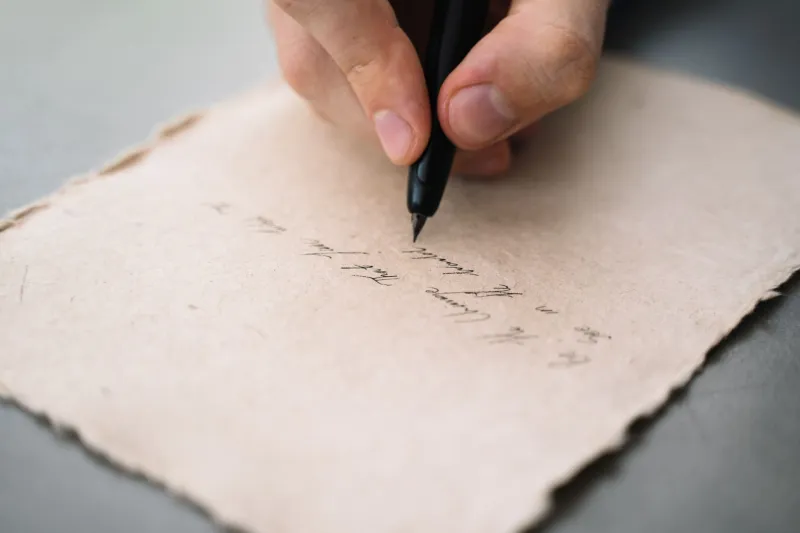
There is a particular quality of attention demanded by a fountain pen. Before the first letter forms, the writer must consider the nib's width, the ink's viscosity, the paper's grain. The act slows. The mind, accustomed to the frictionless pace of digital input, is required to pause—and in that pause, something older and more deliberate takes hold.
This is precisely what draws thousands of Americans to handwriting not as nostalgia, but as practice. From calligraphy guilds in Portland to vintage pen dealers in Philadelphia, from Spencerian script workshops in rural Tennessee to online communities numbering in the hundreds of thousands, a movement has quietly assembled around the proposition that script is not merely a communication tool. It is a cultural artifact, a physical record of the self, and an art form worth defending.
A Skill Reclassified as Ornament
The institutional retreat from cursive instruction in American public schools began in earnest following the adoption of Common Core standards in the early 2010s, which did not require cursive as part of the language arts curriculum. Within a few years, school districts across the country had quietly phased out handwriting instruction in favor of keyboarding skills. The decision was framed as pragmatic—a calibration of education toward the demands of a digital economy.
What was lost in that recalibration is harder to quantify. Researchers in cognitive neuroscience have documented that the physical act of handwriting engages the brain differently than typing, activating regions associated with memory formation, language processing, and fine motor coordination in ways that keyboard input does not replicate. For practitioners in the handwriting preservation community, this evidence is less a revelation than a confirmation of something they had always understood intuitively.
"When you write by hand, you are not simply recording information," explains Margaret Hollowell, a penmanship instructor and historian based in Asheville, North Carolina, who has spent more than two decades teaching Copperplate and Italic scripts. "You are making a decision about every letter. That deliberateness leaves a trace—not only on the paper, but in the person writing."
The Instrument as Artifact
For collectors of vintage writing instruments, the pen itself carries its own cultural weight. American manufacturers such as Wahl-Eversharp, Conklin, and the early iterations of Parker and Sheaffer produced pens throughout the early twentieth century that are now sought as objects of significant craftsmanship—hard rubber casings, hand-ground nibs, lever-fill mechanisms that speak to an era when writing tools were designed to last a lifetime.
Daniel Reyes, a collector and restorer in Chicago, has spent fifteen years acquiring and rehabilitating vintage American fountain pens. His collection spans nearly a century of domestic production, and he approaches each restoration with the care of a conservator working on fragile documents. "These pens were made to be used, not displayed," he says. "Part of what I do is return them to use. A pen that sits in a case is just an object. A pen that writes is a continuation."
Reyes also participates in pen shows—regional gatherings that take place in cities including Los Angeles, Atlanta, and Washington, D.C.—where collectors, dealers, and enthusiasts convene to trade instruments, exchange knowledge, and, critically, to write. The shows function as something between a marketplace and a cultural salon, drawing participants who range from seasoned collectors to young professionals newly introduced to the practice.
Script as a Form of Witness
Beyond the instrument lies the deeper question of what handwriting, practiced as a discipline, actually preserves. Calligraphers working in traditions such as Spencerian, Copperplate, Uncial, and the various regional American scripts of the nineteenth and early twentieth centuries are not simply maintaining aesthetic techniques. They are maintaining modes of expression that carry within them the values, aesthetics, and social conventions of the periods that produced them.
Dr. Annette Farrow, a graphological historian at a liberal arts college in Ohio, studies the evolution of American handwriting styles as a lens into cultural history. Her research traces how shifts in penmanship instruction—from the ornate flourishes of nineteenth-century business script to the simplified Palmer Method adopted widely in the early 1900s—reflect broader changes in American commercial culture, immigration patterns, and educational philosophy.
"Every dominant script of an era tells you something about what that era valued," Farrow notes. "The Palmer Method was efficient and uniform because efficiency and uniformity were what American industry needed. When we lose access to earlier scripts, we lose a certain kind of literacy—the ability to read our own history in its original hand."
This archival dimension of the movement has drawn increasing attention from institutions. Libraries and historical societies have begun partnering with calligraphy guilds and penmanship instructors to train volunteers capable of transcribing handwritten documents—letters, diaries, ledgers, legal records—that remain inaccessible to researchers because too few people can read the scripts in which they were composed.
Letters as Intimate Documents
Perhaps the most quietly radical aspect of the contemporary handwriting movement is its embrace of the personal letter as a form of cultural production. Organizations such as the Letter Writers Alliance, which originated in Chicago, have cultivated communities of correspondents who exchange handwritten letters as a deliberate counterpoint to the ephemerality of digital communication.
The handwritten letter, advocates argue, carries a different kind of authority than any digital message. It bears the physical evidence of its author—the pressure of the pen, the idiosyncrasies of individual letterforms, the occasional correction or afterthought written in the margin. It is, in the most literal sense, irreproducible.
"A typed message can be copied infinitely and identically," observes Hollowell. "A handwritten letter cannot. It exists once, in one place, and it carries the hand of the person who wrote it. That singularity is not a limitation. It is the entire point."
The Resistance in the Gesture
What unites the collectors, instructors, scholars, and correspondents who constitute this movement is not a uniform rejection of digital life—most navigate both worlds with ease—but a shared conviction that certain forms of human expression carry irreplaceable value precisely because they are slow, particular, and resistant to replication.
In this sense, the act of taking up a pen and forming letters by hand has become, for its practitioners, something more than a hobby or an aesthetic preference. It is a form of cultural insistence: a refusal to cede entirely to the logic of speed and uniformity that governs so much of contemporary communication.
The ink dries. The letter is folded, addressed, and sent. Somewhere, on a specific piece of paper, in a hand that belongs to no one else, a record is made. That record will not be indexed, will not be searchable, will not be replicated. It will simply exist—as evidence that someone, in a particular moment, chose to write.