Made Where They Stand: Public Art That Answers to the Block, Not the Bureaucracy
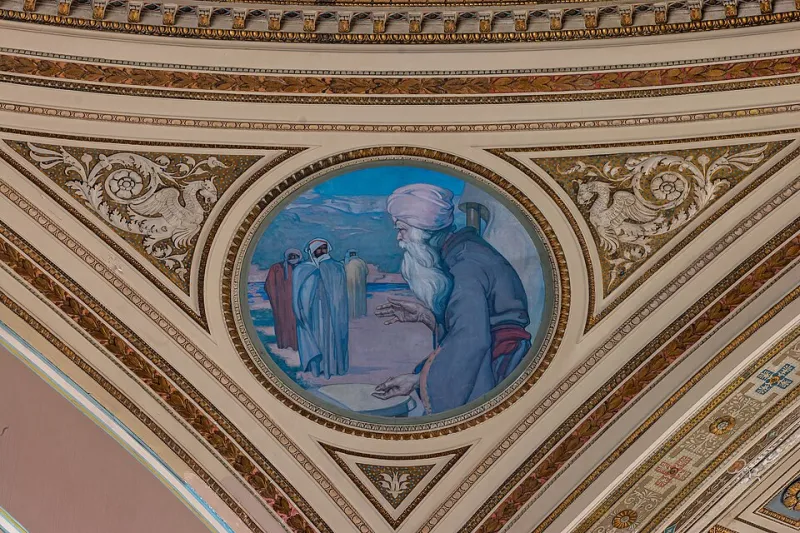
Photo: paintings by Myron G. Barlow photography by Helmut Ziewers,, CC BY-SA 4.0, via Wikimedia Commons
Public art in the United States tends to follow a familiar pipeline: a municipal percent-for-arts ordinance, a selection committee, a fabricator, a plaque. The results are often handsome and occasionally great. But a different tradition runs parallel to it — work conceived in living rooms and church basements, funded by bake sales and block parties, and maintained for decades by the people who see it every day. This is art that belongs to its neighborhoods in the most literal sense. Ten examples, drawn from across the country, show what that ownership looks like.
The List
1. The painted alleys of the Fruitvale district, Oakland, California. Begun as collaborative mural projects between longtime Latino residents and youth artists, these corridors of color document migration, labor, and family history — and are repainted by volunteers whenever tagging or weather demands it.
2. The community-built totems and carvings of the Pacific Northwest, Seattle, Washington. In several neighborhoods, Coast Salish and urban Native artists have created works with, not merely for, local communities — with maintenance decisions resting with cultural councils rather than city hall.
3. The South Side murals of Chicago, Illinois. From the wall paintings of the 1960s and '70s onward, Chicago's neighborhood mural tradition has treated walls as civic newspapers, with block clubs acting as informal curators ever since.
4. The Philadelphia Mural Arts legacy pieces, Pennsylvania. What began as an anti-graffiti program evolved into thousands of works, many of them designed through community painting days where hundreds of residents held a brush.
5. The roadside monuments of the Mississippi Delta, Mississippi. Hand-built memorials to blues musicians, civil rights figures, and local ancestors — welded, poured, and painted by neighbors, restored by the same hands.
6. The Chinatown gateways and lantern installations, San Francisco, California. Designed with merchant associations and community elders, these works announce cultural presence in the face of displacement pressure.
7. The borderlands murals of El Paso, Texas and Ciudad Juárez. Binational in authorship and audience, maintained by families on both sides of a line the art ignores.
8. The Puerto Rican flag murals of Humboldt Park, Chicago, Illinois. Painted and repainted across generations, they have become the visual anchor of community identity — and a flashpoint when developers arrive.
9. The quilt-inspired installations of Gee's Bend, Alabama. A remote Black community whose celebrated textile tradition now extends into public display, curated by the women who made it.
10. The waterfront carvings and markers of the Maine coast. Fishing villages where memorial works to lost sailors are commissioned by families, not committees, and tended like gravestones.
What Happens When Developers Come Knocking
The pattern repeats from coast to coast: a neighborhood's art gains a reputation, the neighborhood gains value, and the art becomes a marketing asset for the very forces that might displace its makers. Residents in several of the communities above have responded with preservation agreements, oral-history documentation, and in some cases repainting as an act of refusal.
The lesson is uncomfortable for institutions but clarifying all the same. Authorship determines loyalty. A mural chosen by committee can be removed by committee. A mural chosen by a block tends to be defended by a block — and that, more than any budget line, is what makes public art public.