The Shelf as Oracle: Why Independent Bookstores Have Become America's Most Trusted Curators
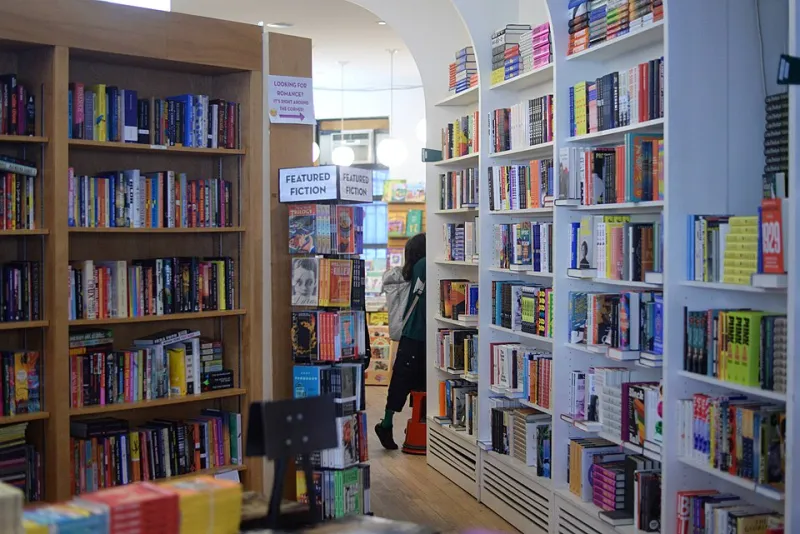
Photo: Sashimi-b, CC BY 4.0, via Wikimedia Commons
The algorithm will tell you what you have already read. It will identify patterns in your history, cross-reference them against the histories of people who resemble you, and return a list of titles that confirm what it already knows about your preferences. The process is efficient, statistically defensible, and — by the account of a growing number of readers — almost entirely useless as a means of genuine discovery.
Walk into an independent bookstore, by contrast, and something different happens. A bookseller notices what you are carrying. A conversation begins. Within minutes, you are holding a novel you have never heard of, written by an author you did not know existed, addressing a question you did not realize you were asking. You buy it. You read it. It changes something.
This is not an accident. It is the product of expertise, attention, and what can only be described as curatorial instinct — a quality that no platform, however sophisticated, has yet succeeded in engineering.
The Quiet Renaissance
Independent bookstores in the United States have experienced a sustained period of growth that defies the narrative of their supposed obsolescence. According to the American Booksellers Association, the number of independent bookstores in the country has increased significantly over the past decade, reversing a long decline that many observers once considered irreversible. New stores are opening in cities and small towns alike, often in communities that had gone without a dedicated bookselling presence for years.
The reasons for this resurgence are various and well-documented. But one factor that receives comparatively little attention is the degree to which independent bookstores have come to occupy a curatorial role that was once the province of literary editors, newspaper book sections, and prize committees — institutions that have either contracted dramatically or lost the trust of a reading public that has grown skeptical of establishment taste.
In their place, the independent bookseller has emerged as something genuinely new: a trusted recommender whose authority derives not from institutional affiliation or critical credentials, but from proximity to readers and an intimate knowledge of what moves them.
Curation as Vocation
At a small bookstore in Minneapolis that opened six years ago in a converted storefront, the owner and head bookseller describes her approach to stocking shelves as a form of ongoing conversation with her community. "I am not trying to carry everything," she explains. "I am trying to carry the right things for the people who come here. That requires knowing them — not as data points, but as people with specific lives and specific needs."
Her store's staff picks, displayed prominently near the entrance, have developed a regional reputation that extends well beyond the store's immediate neighborhood. Publishers have begun sending advance copies specifically in hopes of a placement on those shelves, recognizing that a recommendation from this particular bookseller carries measurable weight.
This pattern repeats across the country. In Portland, Oregon, a bookstore specializing in translated literature and small-press fiction has become a primary discovery mechanism for readers who feel underserved by mainstream retail and digital platforms. In Nashville, a store with a particular focus on Southern writing has helped establish the careers of several authors who went on to national recognition. In Brooklyn, a bookseller known for her expertise in debut literary fiction regularly surfaces titles months before they acquire wider attention.
What these figures share is not a particular genre specialty or a demographic target. What they share is the willingness to stake their reputation on a judgment — to say, in effect, this matters, and here is why — and the depth of knowledge required to make that judgment credibly.
The Trust Deficit and Its Consequences
The ascendancy of the independent bookseller as cultural curator cannot be understood apart from the broader context of eroding trust in algorithmic recommendation. Streaming platforms and e-commerce sites have invested enormous resources in developing systems designed to predict and shape consumer taste. By most technical measures, these systems are impressive. By the measure of the readers who use them, they frequently fall short.
The complaint is consistent and specific: algorithmic recommendations tend to optimize for what is already popular, already familiar, already within the range of a user's established preferences. They are, by design, conservative instruments. They reduce the risk of disappointment by reducing the possibility of surprise.
This is precisely the opposite of what a skilled bookseller does. A skilled bookseller accepts the risk of the unexpected recommendation because the unexpected recommendation is, in many cases, the most valuable one. The willingness to say you have not heard of this, and that is exactly why you should read it requires a quality of trust — between recommender and reader — that no algorithm has yet been designed to earn.
"People come in here because they want to be surprised," says the owner of a bookstore in Austin, Texas, that has developed a devoted following for its unconventional staff picks and deliberately idiosyncratic inventory. "They have already spent time online being told what they want. They come here to find out what they did not know they wanted. That is a completely different transaction."
What the Bookstore Knows That the Platform Does Not
Beyond the mechanics of recommendation, independent bookstores offer something that digital platforms are structurally incapable of providing: a physical space in which culture is encountered as a social experience rather than a private consumption event.
The bookstore as community institution — hosting readings, convening book clubs, providing space for conversation about difficult subjects — performs a function that is distinct from, and arguably more important than, its function as a retail outlet. It is a place where the act of reading is treated as something worth gathering around, worth discussing, worth disagreeing about in public.
This dimension of the independent bookstore's role has become increasingly visible in recent years, as these spaces have taken on programming that would once have been the province of libraries, universities, or civic organizations. In communities where those institutions have contracted or grown less accessible, the bookstore has quietly stepped into the gap.
Curation as an Act of Integrity
At Aurator, we are committed to the proposition that genuine curation — the act of selecting, contextualizing, and presenting cultural work with care and intentionality — is among the most valuable services a cultural institution can provide. Independent bookstores, at their best, embody this proposition with a fidelity that few institutions match.
They are not neutral conduits. They have points of view. They make arguments with their shelves. They bet their credibility on books that have not yet found their audiences, and they accept the consequences when those bets do not pay off. This is what distinguishes curation from aggregation, and what distinguishes a trusted cultural guide from a data-driven recommendation engine.
The reading public, it turns out, knows the difference. And it is voting accordingly — not with clicks, but with the far more consequential currency of its attention.