Marked by Hand: The Craft Artists Turning Imperfection Into a Cultural Statement
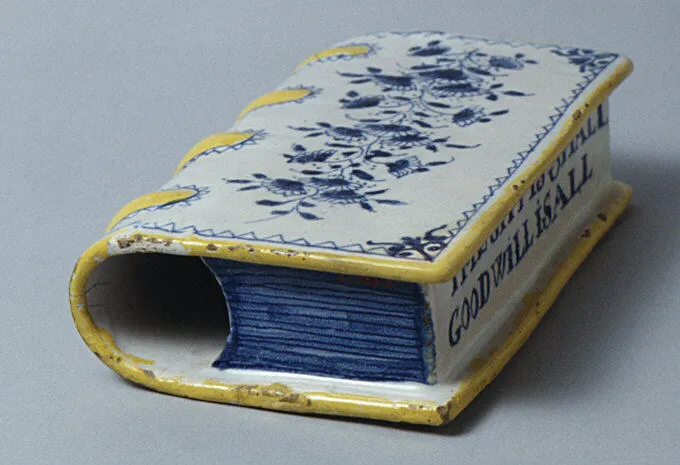
Photo: Unknown, CC0, via Wikimedia Commons
There is a quiet revolution happening on the shelves of American galleries, in the studios of emerging makers, and across the tables of craft fairs from Portland, Oregon, to Asheville, North Carolina. It does not announce itself with manifestos or march in protest. It announces itself in the thumb impression left in the wall of a stoneware bowl. It speaks through the deliberate irregularity of a hand-woven textile, the intentional wobble of a thrown vessel, the visible knot in a piece of macramé that a machine would never have left behind.
This is the handmade aesthetic — and it is not a nostalgic retreat. It is, increasingly, a considered philosophical position.
The Seamless World and Its Discontents
For the better part of two decades, the dominant visual language of consumer culture has trended relentlessly toward the frictionless. Products are smooth, symmetrical, and interchangeable. Digital tools have made it possible to produce images, objects, and surfaces that betray no evidence of the human hand that shaped them. The result is an environment of extraordinary technical precision — and, for many observers, an environment that feels increasingly hollow.
Contemporary craft artists are responding to this condition not by abandoning skill, but by redefining what skill means. Where industrial production treats consistency as the highest virtue, these makers treat variation as evidence of genuine presence. The mark of the hand is not a mistake to be corrected; it is the point.
"There is something that happens when you hold a cup that was made by a person," says Maya Okafor, a ceramicist based in Detroit whose work has been shown at galleries in Chicago and New York. "You can feel the decision-making in the clay. Someone chose to leave that impression. That is a form of communication that a mold cannot replicate."
Okafor's pieces sell out quickly, often within hours of being listed online. Her buyers, she notes, are not simply purchasing functional objects. They are purchasing evidence of a human encounter with material.
Philosophy in the Firing
The intellectual underpinnings of this movement are not new. The Arts and Crafts movement of the late nineteenth century, led by figures such as William Morris, argued passionately against industrial uniformity and in favor of the dignity embedded in handwork. The Japanese aesthetic concept of wabi-sabi — an appreciation for the impermanent, imperfect, and incomplete — has circulated in Western design discourse for decades.
What is new is the cultural context in which these ideas are being revived. Today's craft artists are not reacting primarily against factory floors. They are reacting against algorithms, against the optimization logic of platforms that smooth every edge in pursuit of maximum appeal, against a visual culture that has learned to generate images of handmade objects without the labor of actually making them.
"I think about it as a kind of resistance to legibility," says textile artist Jonah Reyes, who works from a studio in Taos, New Mexico, producing large-scale woven pieces that incorporate deliberate structural inconsistencies. "Everything online is designed to be immediately comprehensible, immediately consumable. I want my work to require something from the viewer. I want there to be a moment of uncertainty before the recognition."
Reyes's work, which has been acquired by several university collections, is notable for its refusal of the decorative. The imperfections in his weaves are not ornamental; they are structural arguments.
Reshaping the Gallery
The influence of this philosophical shift extends beyond individual studios. Gallery directors across the country are reporting a noticeable change in what collectors and general visitors are responding to. Spaces that once favored the clean lines of minimalist design are now making room for objects that carry visible evidence of their making.
At a mid-sized contemporary craft gallery in Philadelphia, the curatorial director described a deliberate pivot in recent programming. "We spent years presenting work that was technically immaculate," she said. "What we are seeing now, both from artists and from audiences, is a real appetite for work that does not hide its origins. People want to understand how something came to exist."
This shift has practical implications for how gallery spaces are designed. Pedestals are being lowered. Lighting is being adjusted to emphasize texture rather than minimize it. Labels increasingly describe process alongside concept, inviting visitors to consider not just what a work looks like but what it required.
The Consumer as Witness
Perhaps the most significant dimension of this movement is what it suggests about changing consumer expectations. For years, the dominant assumption in the design and retail industries was that consumers wanted perfection — that any visible irregularity would register as a defect and therefore a deterrent to purchase.
The evidence increasingly suggests otherwise. Platforms that specialize in handmade goods have reported sustained growth, with buyers explicitly citing the visible marks of human labor as a primary motivation. In surveys and interviews, customers describe a desire not merely for unique objects but for objects that carry what one maker called "proof of life" — evidence that a human being was genuinely present in the act of creation.
"People are exhausted by the perfected image," says ceramicist and educator Priya Subramaniam, who teaches at a craft school in Vermont and maintains a small production practice alongside her teaching. "They have been looking at perfectly lit, perfectly filtered, perfectly composed images of handmade objects for so long that they have lost the ability to trust them. When something is genuinely irregular, it registers as real. That is not a small thing."
Subramaniam's observation points to a deeper cultural hunger — one that this publication has observed across multiple creative disciplines. In an environment saturated with optimized content, the authentic mark has become one of the rarest and most valued things a culture can produce.
What the Movement Asks of Us
To take the handmade aesthetic seriously is to accept a certain kind of slowness. These objects take longer to make, longer to understand, and longer to integrate into a life than their mass-produced counterparts. They ask for attention rather than offering immediate satisfaction.
In this sense, the contemporary craft movement is not simply an aesthetic preference. It is a proposal about how we might choose to spend our attention — and about what we lose when we allow the seamless to become the default. The fingerprint in the clay, the uneven weft of the loom, the knot that a machine would have smoothed away: these are not failures of production. They are, in the most precise sense of the word, signatures.
And in a culture that has grown increasingly skilled at producing everything except evidence of itself, a signature is worth more than it has been in a very long time.